


Every healthcare marketing plan for 2027 has to answer one uncomfortable question first.
Can you prove it worked?
That question carries more weight now than it did five years ago. Impressions were fine. Website traffic was fine. A polished social feed was fine. But reimbursement pressure is growing, employer health costs keep climbing and hospital, practice and MSO leadership increasingly want marketing activity tied to something closer to the business outcome. A patient walking through the door. An appointment booked. A referral completed. A service line growing.
This is not a list of channels to try in the new year.
It is a strategy problem.
And treating it like a tactics checklist is exactly how healthcare organizations end up with a full content calendar and a flat patient acquisition number.
The evidence behind that pressure is already visible. Marsh’s September 2026 employer survey projects an 8.2% increase in average U.S. health benefit cost per employee for 2027, even after planned cost-reduction measures. CMS is also implementing Medicaid financing changes that begin taking effect in 2027.
At the same time, patient discovery is changing quickly. KFF found in March 2026 that 32% of U.S. adults had used AI for health information or advice during the previous year. Traditional internet search remained much larger at 68%, but the pattern is hard to ignore.
So the question for healthcare leaders is not simply, “Which new marketing tactic should we try in 2027?”
A better question is this.
How should the marketing system change as patient behavior, search, costs, privacy expectations and executive expectations change around it?
That is what this guide is built to answer.
Note: The market evidence discussed here is primarily U.S.-based. The broader strategic principles may apply elsewhere, but privacy, advertising and regulatory decisions should always be adapted to the jurisdiction involved.
What is a Healthcare Marketing Strategy?
A healthcare marketing strategy is the plan that connects an organization’s growth priorities with the patients or customers it needs to reach, the reasons those people choose care, the places where those decisions happen, the experience that converts interest into access and the measurement needed to understand business impact.
That definition matters.
Healthcare marketing strategy is not the same thing as a channel plan. SEO is not the strategy. Paid advertising is not the strategy. Content is not the strategy. Social media is not the strategy. Those are executions of the strategy.
Most of what gets labeled a healthcare marketing strategy is still a tactics list wearing a strategy’s name. A real strategy starts one level higher.
It asks a different set of questions.
- Where does the organization need to grow?
- Which patients, markets or referral sources matter most?
- What prevents those people from choosing or accessing the organization?
- Where are healthcare decisions actually being shaped?
- What combination of brand, media, content, technology and operational changes can remove those barriers?
- How will the organization know whether the strategy worked?
And one more question deserves to sit behind all six.
Does the organization actually have the staff, systems, appointment capacity and budget to deliver on the demand marketing creates?
Skip that part and you can build a beautiful campaign the intake team cannot handle.
That distinction will matter more in 2027 because marketing problems and operational problems are becoming harder to separate
The 2027 Healthcare Marketing Forecast at a Glance
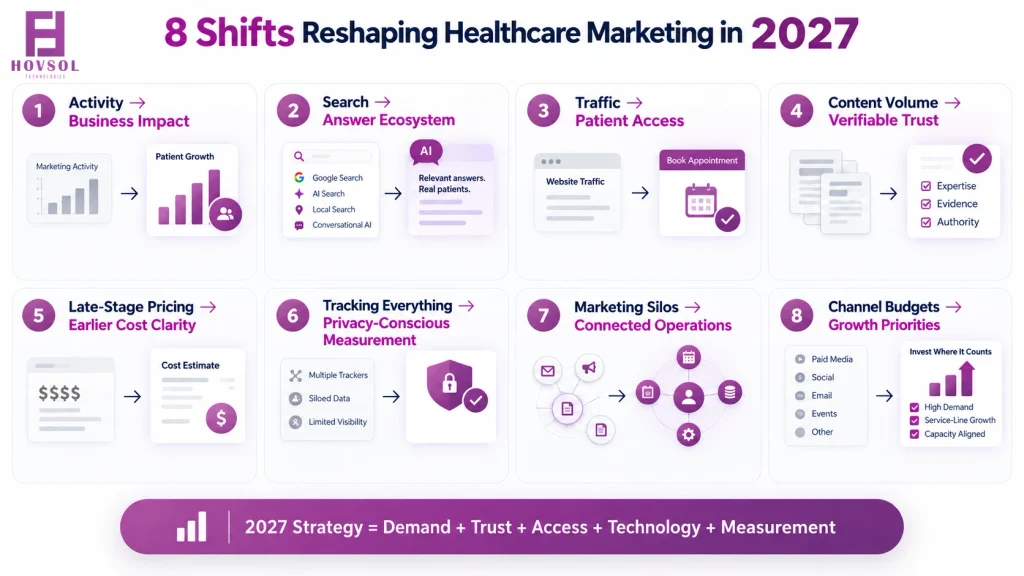
| Shift | What is changing | Strategic response |
|---|---|---|
| Marketing accountability | Executives want clearer business impact | Measure patient and service-line outcomes, not activity alone |
| AI-driven discovery | Patients increasingly ask AI systems health questions | Optimize for search, AI answers and trusted expert visibility |
| Media mix | Attention is fragmenting across connected TV, social, search and clinician-led content | Allocate media around patient behavior rather than legacy channel habits |
| Patient access | Scheduling and information friction affect provider choice | Treat access as part of conversion strategy |
| Trust | Patients face more information but also more uncertainty | Invest in credible expertise, reputation and transparency |
| Affordability | Healthcare costs remain a major concern | Bring price, insurance and financial expectations earlier into the journey |
| Privacy and targeting | Healthcare data use faces tighter practical limits | Build privacy-conscious measurement and first-party data foundations |
| Marketing + operations | Leads can be lost after the campaign ends | Connect marketing, CRM, scheduling, call handling and follow-up |
| Growth allocation | Not every service line needs more demand | Allocate marketing around capacity, economics and strategic priorities |
Shift 1: Healthcare Marketing Will Be Expected to Prove Business Impact
Clicks still matter.
So do impressions, rankings, engagement rates and cost per lead.
But they are increasingly incomplete answers to the question healthcare executives actually care about.
What did the investment accomplish?
This shift is already visible. McKinsey has argued that healthcare CMOs, technology leaders and CFOs need stronger alignment around consumer journeys and attribution because disconnected systems make it difficult to connect marketing with actual patient outcomes.
The financial environment makes that conversation harder to avoid.
Marsh’s preliminary 2027 estimate projects the largest annual employer health-benefit cost increase since 2003. CMS changes affecting Medicaid financing also begin phasing in during 2027.
The implication for healthcare marketing teams is fairly simple.
A campaign report that ends at “lead generated” will become less useful.
Build the measurement chain further into the patient journey
Where systems and privacy requirements allow, marketers should work toward understanding a longer chain.
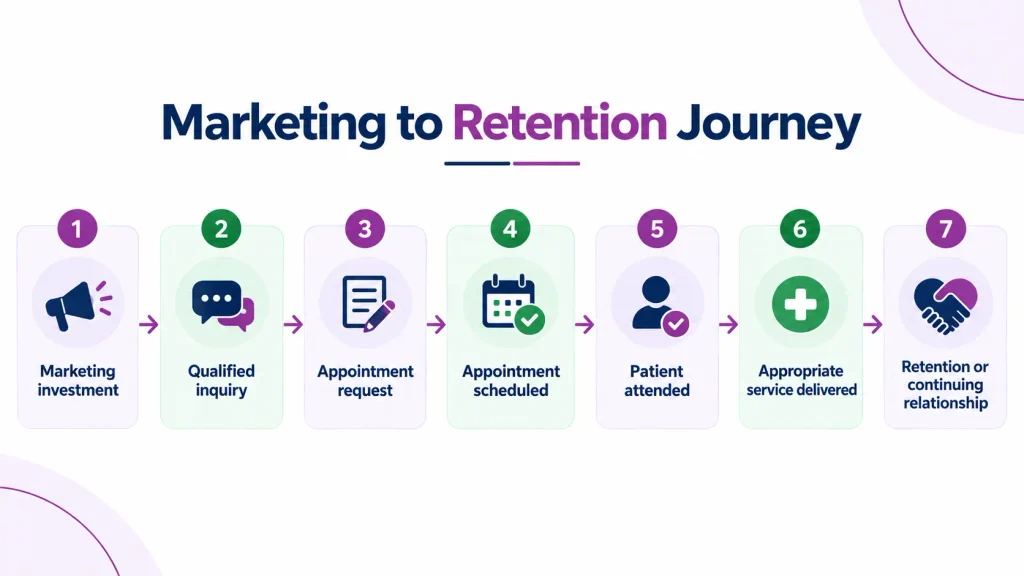
Not every organization will be able to connect every step.
That is fine.
The goal is to gradually reduce the distance between the metric marketing optimizes and the business outcome leadership cares about.
For a hospital, that might mean growth in a strategic service line.
For an MSO, it may mean new patients by location or specialty.
For a behavioral health provider, it could mean qualified intake starts rather than raw lead volume.
For a medical group, it may be the percentage of inquiries that become attended appointments.
That changes budget discussions too.
Instead of asking, “Which channel had the lowest CPL?” leadership can ask a much better question, “Which investment produced patients we had the capacity and strategic reason to serve?”
Shift 2: SEO Will Further Expand into AI Discovery and Answer Visibility
Google is still enormously important but no longer only a list of ten blue links. And Google itself is not the only place where patients ask questions.
KFF’s 2026 research found that about one-third of U.S. adults had used AI tools for health information or advice in the previous year. People reported using these tools to research symptoms, understand tests and diagnoses, compare treatment options and decide whether to seek care.
Search behavior inside Google has changed as well. Pew Research Center examined browsing behavior from U.S. adults and found that when an AI summary appeared, traditional search-result clicks occurred in 8% of visits compared with 15% when no AI summary appeared. Clicks on sources directly inside an AI summary were even rarer.
This does not mean healthcare SEO is dying. It means SEO has another job.
Healthcare discoverability now works across an answer ecosystem
Your organization may need to appear when someone searches things like
- “orthopedic surgeon near me”
- “best treatment options for knee arthritis”
- “how long is recovery after knee replacement?”
- “questions to ask before choosing a fertility clinic”
- “what type of doctor treats this condition?”
But patients may ask those questions through traditional search, AI Overviews, conversational AI, social platforms or several of them during the same decision.
That requires a stronger content architecture than simply publishing more blogs.
Optimizing content for semantic and AI search means creating pages around topics, entities, patient intent and related questions rather than focusing only on individual keywords. Search engines and AI systems need enough context to understand how providers, services, conditions, treatments and locations connect. Clear headings, direct answers, comprehensive topic coverage and consistent terminology can make healthcare content easier for these systems to interpret, summarize and surface when patients ask relevant questions.
Healthcare organizations should make it easy for search and answer systems to understand
- who the organization is
- where it operates
- what services it provides
- which providers deliver those services
- what conditions and patient questions those services relate to
- what differentiates the care experience
- which claims are supported by qualified expertise
- how someone can take the next appropriate step
Clinician-reviewed educational content becomes more valuable here and so do clear provider pages, location information, structured service content, FAQs, credible citations and consistent business information across the web.
We would not recommend replacing SEO with an “AI search strategy” as it creates another silo. Build one discoverability strategy that accounts for traditional search, local search and AI-mediated discovery together.
Shift 3: The Channel Mix is Moving, and Not Subtly
The strategic shift is not limited to Google and AI.
The media mix itself is changing.
Linear television is not suddenly irrelevant in healthcare. That would be too simple. But health systems that built a large part of their brand strategy around the traditional thirty-second hospital spot should be asking whether that media mix still matches how their audience consumes information in 2027.
Connected TV and programmatic video create different possibilities. It opens opportunities for more targeted distribution, more flexible creative, better links between media exposure and downstream behavior where appropriate measurement is available.
That does not mean every hospital should pull money out of television and pour it into CTV next quarter.
Channel shifts are not strategy. They are inputs to the strategy.
A regional health system with broad household reach goals may have a very different case for connected television than a specialty practice trying to capture immediate local search demand.
The same thing is happening at the point of care.
Dense brochures have a hard job ahead of them. Patients increasingly need short, understandable information that answers the question in front of them rather than a wall of copy built around the organization’s preferred messaging.
Cost matters.
Access matters.
Next steps matter.
So does timing.
The strongest point-of-care materials will increasingly feel modular. Easy to scan. Built around the actual conversation between a patient, clinician or care coordinator.
Early-stage education is shifting too. Short-form social and physician-led content can do something a polished branded ad often cannot. Put a real expert in front of the patient.
Instead of throwing money at random influencers, start closer to home.
Ask yourself,
Which physicians or clinicians inside the organization already communicate clearly? Who can explain a condition or treatment without slipping into jargon? Who can answer the exact questions patients are already asking online? And a question many guides simply ignore, which clinical expert has the capacity to help out marketing efforts?
Give those people a platform. Not a single one-off video shoot that disappears into a campaign folder. A real platform. The broader lesson is straightforward.
Do not carry a 2024 media mix into 2027 simply because the budget spreadsheet already has those rows.
Shift 4. Patient Access Will Become Part of Marketing Performance
Imagine two organizations.
Both rank on Google.
Both run good paid campaigns.
Both have strong reviews.
One lets a patient find the right physician, confirm the location, understand basic insurance information and request an appointment without friction.
The other sends the patient through six pages, an outdated provider profile and a phone tree.
As you can see, they do not have the same marketing problem.
Press Ganey’s consumer-experience research gives this issue real weight. Its published findings report that 59% of consumers use online search when looking for a new primary care provider while 60% rely on referrals. It also reports that 80% say online scheduling influences provider choice.
Even more telling, Press Ganey reports that nearly half of consumers will leave when online provider information is wrong or the information they need cannot be found.
That turns website accuracy, scheduling UX and provider data into growth issues.
The website is no longer only the digital front door
It is part of the access system.
In 2027, healthcare marketers should pay much closer attention to what happens between
“I am interested”
and
“I successfully accessed care.”
That includes
- provider and location accuracy
- mobile usability
- page speed
- insurance information
- appointment availability
- clear next steps
- call handling
- form completion
- scheduling workflows
- lead routing
- follow-up speed
- communication after an inquiry
Sometimes increasing patient acquisition requires more traffic. Sometimes it requires fixing what happens to the traffic you already have. Simply throwing a new ad campaign cannot repair a broken scheduling workflow.
Shift 5: Trust Will Become More Valuable as Health Information Becomes Easier to Generate
AI can produce an answer in seconds.
Social platforms can produce hundreds of opinions in minutes.
Neither guarantees that a patient feels confident.
KFF found a revealing split in 2026. People who had used AI for health information often reported satisfaction with the answers but trust across the broader public remained much lower. The same research found 77% of adults were concerned about the privacy of personal medical information given to AI tools.
McKinsey’s 2025 Consumer Health Insights research, published in 2026, also found broader confidence problems. About one-third of surveyed consumers said the healthcare industry performed below their expectations and half said it failed to meet society’s needs.
This creates an odd marketing reality.
Information is becoming cheaper.
Credibility is not.
Healthcare brands should think beyond content volume.
A 2027 content strategy should make expertise easier to verify.
That can include
- clear author and medical-review information
- detailed physician and specialist profiles
- source-backed educational material
- transparent explanations of procedures
- realistic discussion of benefits, risks and limitations
- patient experience information where appropriate
- consistent provider and location listings
- reviews and reputation signals
- original expert commentary
- useful tools that help patients understand decisions
There is another benefit.
The same signals that help a person decide whether information is trustworthy can also make content easier for search engines and AI systems to interpret and cite.
More content will not automatically create more authority.
Better evidence can.
Shift 6. Cost and Affordability Will Move Earlier in the Patient Journey
Healthcare organizations have traditionally treated price as something that happens late.
But patients increasingly want that answer earlier.
Part of this is economic. Marsh projects an 8.2% increase in average employer-sponsored health benefit cost per employee in 2027.
Part of it is regulatory and technological. CMS hospital price-transparency rules require hospitals to publish machine-readable pricing information and provide consumer-friendly information about shoppable services. Updated 2026 requirements strengthened elements of those disclosures and CMS has also been seeking feedback about improving the usefulness and comparability of hospital pricing data.
Patients want understandable answers. That means healthcare marketers should review where questions about cost appear in the journey.
Do service pages explain what affects cost?
Can people determine whether their insurance may be accepted?
Is financial-assistance information understandable?
Are price-estimation tools easy to find?
For cash-pay services, is pricing explained clearly where appropriate?
Are call-center and intake teams prepared for affordability questions?
This is not an argument for reducing healthcare decisions to price shopping. Clinical suitability, quality, physician expertise, location, access and insurance can all influence the choice.
The point is simpler.
Cost uncertainty creates friction. Where an organization can responsibly reduce that uncertainty, it should.
Shift 7: Privacy-Conscious Measurement will Become a Strategic Capability
Healthcare marketers want better attribution. At the same time, they operate in one of the least forgiving environments for careless data collection.
HHS guidance explains that tracking technologies can collect information including URLs, IP addresses, device information and user-entered data. A 2024 federal court ruling vacated part of HHS guidance involving certain unauthenticated webpages, which means organizations need to assess current requirements carefully rather than relying on simplified blanket rules.
Advertising platforms add another layer. Google classifies personal health content as a sensitive-interest category and restricts the use of advertiser-curated audiences for those categories.
Taken together, the direction becomes obvious.
Healthcare organizations cannot build their future measurement strategy by copying the tracking playbook of a normal ecommerce brand.
Start with the data flow
Before adding another pixel, CRM integration or automation, teams should understand
- What information is being collected?
- On which pages?
- Which system receives it?
- Which vendors can access it?
- What consent or authorization applies?
- How long is the information retained?
- Which marketing decisions actually require that data?
That conversation should involve marketing, technology, privacy, compliance and legal teams where appropriate. It can feel slower at first. But the alternative is a stack nobody fully understands.
Building a privacy-conscious healthcare marketing technology stack means choosing tools, integrations and measurement practices with data minimization and appropriate access controls in mind from the start. Instead of collecting every available signal simply because a platform allows it, healthcare organizations should focus on the information they genuinely need to understand marketing performance while reducing unnecessary exposure of sensitive or potentially identifiable data. This makes privacy part of the measurement architecture rather than something teams try to address after tracking has already been deployed.
Shift 8: The Boundary Between Marketing and Operations Keeps Disappearing
Here is the part most strategies miss.
A brilliant campaign sitting on top of a broken intake process can be worse than an average campaign that converts reliably.
Why?
Because the broken process wastes money you already spent generating demand.
A healthcare organization launches a strong campaign. Inquiries increase. Good news.
Then the form does not sync with the CRM.
Or it syncs to the wrong location.
Or the lead sits unassigned.
Or someone calls two days later.
Or nobody knows the patient already spoke with another office.
Or the patient is ready to schedule but the next appointment is six weeks away.
From the patient’s side, there is no distinction between a marketing problem, an operations problem and a technology problem.
There was simply one experience.
If marketing is generating demand but leads are getting lost between the website, CRM and internal follow-up process, the problem probably is not the next campaign.
It is the system behind it.
That does not automatically mean a software project.
Sometimes the fix is smaller. A workflow automation that moves an intake form directly into the right queue. A routing rule, a clearer owner, a better follow-up process.
Other times the systems themselves do not match the way a multi-location medical group or MSO actually operates. Then integration or custom software may make sense. The goal is not buying more technology. It is making sure the technology already sitting underneath patient acquisition can actually support the patient journey.
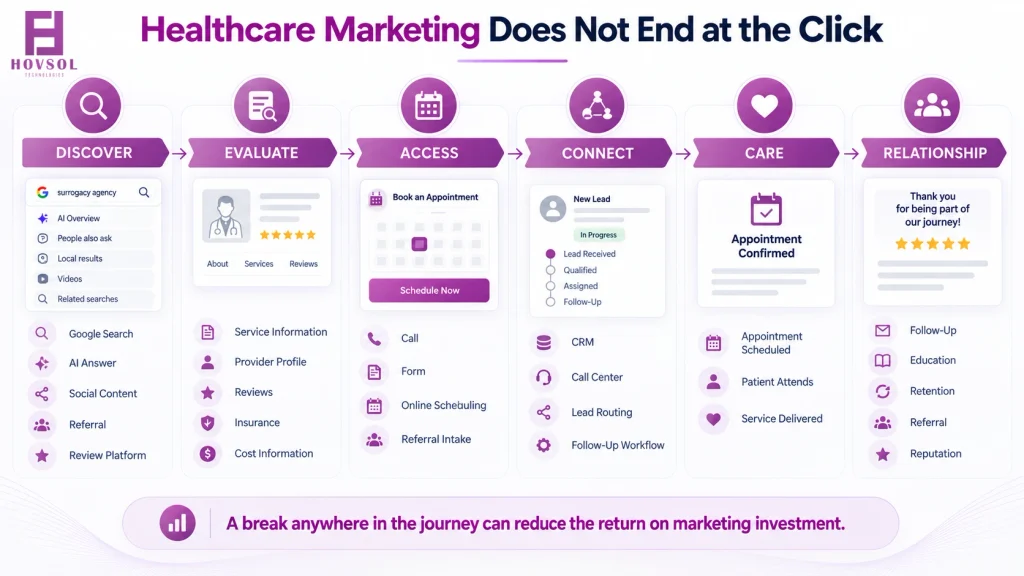
Areas marketing leaders should map with operations
Look closely at the handoffs.
Website → form → CRM → intake → scheduling → reminder → visit → follow-up
Then another path.
Paid call → call center → qualification → location → appointment
And another.
Physician referral → referral intake → outreach → scheduling → referring-provider communication
These flows cross teams, cross systems, and they usually cross departmental ownership too.
Fixing them may require process changes. Sometimes automation. Sometimes integration. Sometimes custom software.
And sometimes nothing more sophisticated than assigning a clear owner.
That is why we prefer to start with the business problem rather than assuming the answer is another marketing platform.
Shift 9: Healthcare Marketing Strategy will Become More Service-Line and Capacity Aware
“Generate more patients” sounds like a sensible goal. Until the service line has no appointment availability. Or marketing creates demand for a low-priority service while a strategically important specialty has open capacity. Or a campaign produces large lead volume from patients outside the useful service area.
A useful 2027 marketing strategy should start with the organization’s growth portfolio.
Score growth opportunities before allocating the budget
| Question | Why it matters |
|---|---|
| Is this a strategic growth priority? | Marketing should follow organizational priorities |
| Do we have clinical and operational capacity? | Demand has limited value if patients cannot access care |
| Is there meaningful market demand? | Capacity alone does not create a market |
| Can we differentiate the service credibly? | Generic offers become expensive to promote |
| Is patient access ready? | Scheduling friction can waste acquisition spend |
| Can we measure the journey? | Measurement affects optimization |
| Is the geographic opportunity attractive? | Demand can vary significantly by market |
This changes the budget conversation.
Instead of asking, “How much should we give Google Ads?”
Ask, “Which growth opportunities deserve investment and what combination of channels can support them?”
That is strategy.
A Healthcare Marketing Strategy Framework to Use in 2027
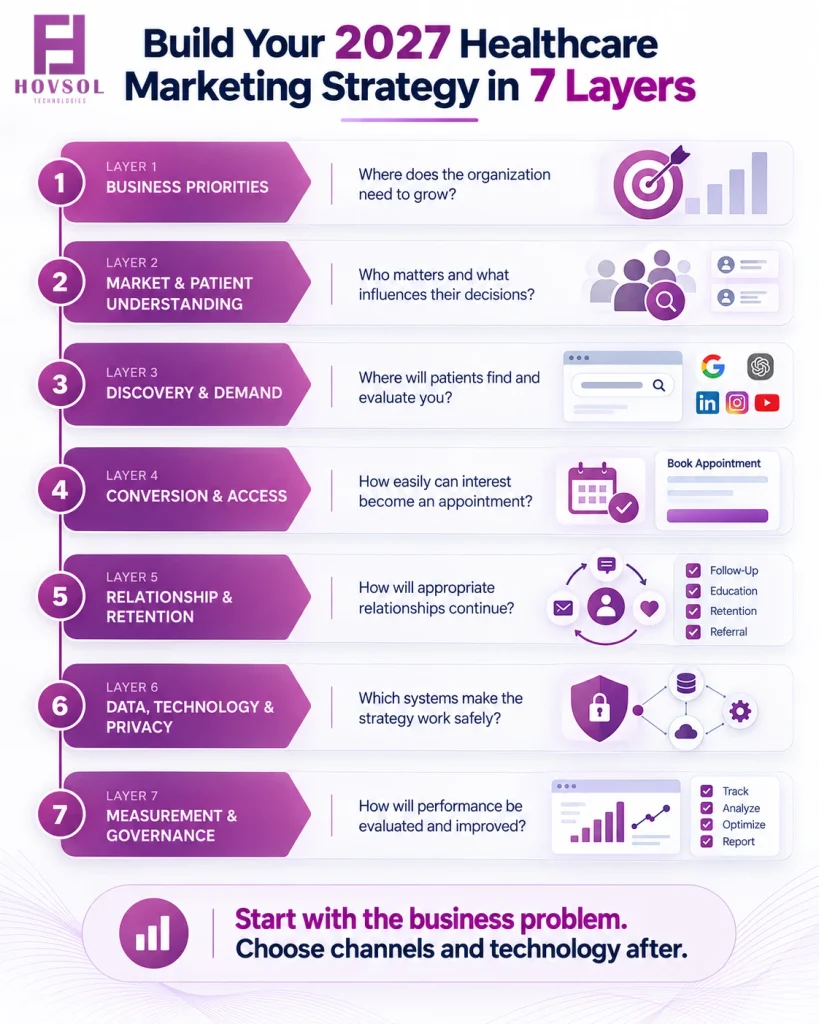
The shifts above can feel like a lot.
They become easier to manage when the strategy is built in layers.
We recommend thinking about seven.
Layer 1. Business Priorities
Start with what the organization needs to accomplish.
Examples might include
- grow an underutilized specialty
- establish a new location
- strengthen referral volume
- increase appropriate patient acquisition
- improve retention
- grow a cash-pay service
- enter a new market
- reduce leakage from existing demand
Do not begin with channels.
Begin here.
Layer 2. Market and Patient Understanding
Define who the organization actually needs to reach.
Study
- patient needs
- referral patterns
- market demand
- geography
- competitors
- payer considerations
- decision criteria
- barriers to care
- patient language
- search behavior
Healthcare audiences are rarely one homogeneous segment.
A patient researching cancer treatment behaves differently from someone choosing an urgent care center.
A fertility patient may research for months.
An orthopedic patient may move quickly once pain starts interfering with everyday life.
Strategy should account for that.
Layer 3. Discovery and Demand
Now decide how the organization will become discoverable.
This may include
- organic search
- local search
- AI search visibility
- paid search
- social discovery
- video
- physician-led educational content
- community visibility
- referral relationships
- earned media
- connected TV or other selected offline and streaming media
The exact mix depends on the business problem.
A CTV campaign might make sense for one health system.
For a specialized local clinic with immediate high-intent demand, search may deserve far more attention.
Trendy channels do not deserve a budget automatically.
Layer 4. Conversion and Access
Ask what the patient needs in order to move forward.
Usually some combination of
- clear information
- confidence
- provider choice
- location information
- insurance information
- understandable cost guidance
- reviews
- scheduling
- phone support
- fast follow-up
Marketing cannot stop at the landing page.
Layer 5. Relationship and Retention
Patient acquisition is expensive when every relationship starts from zero.
Healthcare organizations should decide how they will maintain appropriate relationships after the initial interaction.
Depending on the organization and applicable requirements, that may include
- educational communications
- reminders
- follow-up
- preventive care prompts
- newsletters
- patient portals
- referral communications
- reputation programs
- community programs
The right approach depends heavily on consent, data use and the type of care involved.
Layer 6. Data, Technology and Privacy
Now determine what infrastructure the strategy actually requires.
Possible components include
- CRM
- scheduling platform
- call tracking
- analytics
- data warehouse
- reporting layer
- automation
- patient portal
- referral-management workflows
- integrations between existing systems
Resist the instinct to buy every platform.
More software can create more fragmentation.
Use technology to solve defined problems.
Layer 7. Measurement and Governance
Finally, decide how the strategy will be managed.
Every priority should have
- an owner
- a baseline
- an outcome metric
- leading indicators
- a review cadence
- an agreed data source
- a process for changing the plan
Without governance, even a good strategy becomes a collection of campaigns.
How Should Healthcare Organizations Allocate Marketing Budget in 2027?
Unfortunately, there is no useful universal percentage. A specialty practice, national telehealth brand, regional health system and multi-state MSO have completely different economics. Instead, allocate budget against four questions.
1. Where does the organization have capacity to grow?
Do not spend heavily creating demand that cannot be served.
2. Where is demand already present?
High-intent search, referral demand and local discovery may deserve investment before expensive demand-creation campaigns.
3. Where does the organization need to create future demand?
Brand investment still matters. Performance marketing can harvest demand that already exists. It cannot create every future preference by itself.
4. What needs to be learned?
Keep part of the plan available for controlled experimentation. New search environments, creative formats, media channels and automation deserve testing.
But testing needs a hypothesis.
“We should try TikTok because everybody is on TikTok” is not one.
What a 2027 Digital Marketing Strategy for Healthcare Might Look Like
The exact strategy changes by organization.
Here are three examples.
For A Multi-Location Medical Group
Business issue: Patient growth is uneven across locations.
The wrong response is increasing paid-search spend everywhere.
A stronger plan would first compare
- appointment capacity by location
- search demand
- local rankings
- provider availability
- conversion rates
- call handling
- payer mix where relevant
- competitor density
Marketing can then direct investment toward the locations where demand and capacity align.
At the same time, location and physician data should be cleaned up across search listings and the website.
Now media spending has a business reason behind it.
A Hospital System
Business issue: Leadership wants growth in three priority service lines but attribution is weak.
The strategy could begin by building a shared measurement framework linking campaign traffic with inquiry, scheduling and patient-start data where permissible.
Then evaluate each service line separately.
Cardiology may require physician expertise, referral relationships and long-form education.
Imaging may depend more heavily on local access, referral workflows and appointment convenience.
Elective procedures may require deeper cost and recovery information.
One “hospital marketing strategy” would be too broad.
A Specialty Healthcare Organization
Business issue: Organic traffic is strong but patient inquiries are not growing at the same rate.
Do not assume SEO failed.
Look at the journey.
Are informational pages attracting the wrong audience?
Are AI summaries answering simple questions without sending traffic?
Do service pages explain why and when someone should seek care?
Can people find a provider?
Are calls answered?
Can someone schedule?
The solution may be a mixture of search strategy, conversion work and operational fixes.
That is exactly why channel metrics should not be analyzed alone.
A Practical 90-Day Process for Building Your 2027 Healthcare Marketing Plan
Healthcare organizations do not need to rebuild everything on January 1.
Start with the highest-leverage problems.
Days 1–30. Find the Growth Constraints
Map
- strategic service lines
- patient capacity
- current acquisition sources
- market demand
- search and AI visibility
- conversion paths
- scheduling
- CRM flows
- measurement gaps
- privacy-sensitive data flows
The goal is diagnosis.
Not campaign production.
Days 31–60. Design the 2027 Growth System
Decide
- which audiences matter
- which services deserve investment
- what the core messages should be
- where discovery needs improvement
- where access friction needs fixing
- what data needs connecting
- which metrics leadership will review
- which privacy or compliance questions need specialist review
Prioritize.
Trying to repair twenty problems at once usually means none get enough attention.
Days 61–90. Launch Focused Experiments
Now move.
Examples might include
- improving a high-priority service-line journey
- strengthening local provider discoverability
- building content around high-value patient questions
- testing an AI-search optimization program
- connecting call or scheduling outcomes with campaign reporting
- redesigning an intake workflow
- improving follow-up automation
- testing a new media channel against a defined audience and outcome
Measure what happens beyond the click.
How Should Healthcare Marketing ROI be Measured in 2027?
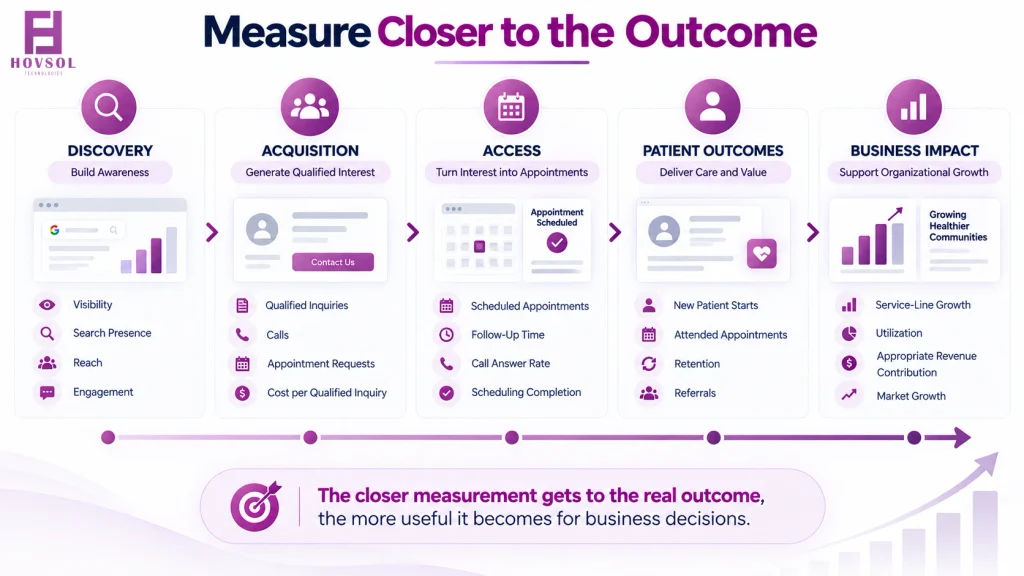
Healthcare marketing ROI should measure how marketing contributes to defined organizational outcomes, not simply how cheaply it generates traffic or leads.
There is still value in channel metrics. Use them as diagnostic indicators.
Discovery metrics
- organic visibility
- local visibility
- AI citation or answer visibility where measurable
- paid impression share
- branded search
- reach
- engagement
Acquisition metrics
- qualified inquiries
- cost per qualified inquiry
- calls
- appointment requests
- referral starts
Access metrics
- inquiry-to-scheduled rate
- scheduling completion
- call answer rate
- follow-up time
- appointment availability
- abandonment
Patient outcome metrics
Where appropriate and measurable
- new patient starts
- attended appointments
- patient acquisition cost
- growth by service line
- retention
- referral activity
Business metrics
Depending on the organization
- service-line growth
- utilization
- patient lifetime relationship
- appropriate revenue contribution
- market growth
- marketing incrementality
No single number explains everything.
The point is to build a measurement chain leadership can actually use.
Common Mistakes Healthcare Organizations Should Avoid in 2027
A few mistakes keep coming back.
Treating the content calendar as the strategy
A twelve-month posting schedule is a plan for output.
Not a plan for growth.
Content needs a job. Supporting discoverability. Explaining a service. Building trust. Helping a patient make a decision. Supporting a referral pathway.
Otherwise it is just inventory.
Chasing AI search visibility while ignoring the basics
A perfectly structured FAQ page does not help much when your provider directory lists the wrong location.
Or your physician page is outdated.
Or the phone number goes nowhere.
AI search does not make the fundamentals less important.
It makes inconsistency easier to expose.
Overcorrecting toward pure performance marketing
Paid search and PPC are good at capturing demand that already exists.
They are not built to create every piece of trust a patient needs before deciding where to receive care.
Healthcare converts trust as much as convenience.
A strategy that forgets that may optimize the dashboard while weakening the brand.
Reporting traffic as the final outcome
Traffic without the right patient journey can be noise. Look further downstream.
Measuring lead generation separately from lead handling
Poor follow-up can make a good campaign look bad. And it can make an expensive campaign even more expensive.
Treating every service line the same
Different healthcare decisions require different marketing systems.
Different buying journeys.
Different proof.
Different timing.
Adding marketing technology before mapping the workflow
Buying another platform rarely repairs a broken process.
Start with the workflow.
Then decide whether technology has a role.
Treating privacy review as something that happens after launch
Healthcare data architecture should influence campaign design from the beginning.
Not after the tracking stack is already live.
Questions Healthcare Leaders Should Ask Before Approving the 2027 Plan
Before signing with a marketing or technology partner, or even before approving the internal plan, ask the team to walk through a few things.
Not the pitch deck.
The actual journey.
1. Can you show me how a patient or lead moves from first interaction to booked appointment today?
Do this before discussing the new campaign. It exposes gaps quickly.
2. What happens during the first 24 hours after someone responds?
Who owns the lead? Where does it go? What happens when nobody responds?
3. Who owns the patient and lead data?
This matters during the engagement. It matters even more when a vendor relationship ends.
4. How will we know within the first 90 days whether the strategy is working?
Not every business result will appear in three months. But the team should still know which leading indicators will show whether the plan is moving in the right direction.
5. What in our current setup could limit the results?
Is it Technology? Scheduling? Capacity? Data? Intake? Internal ownership?
These questions tell you more about a partner than a polished list of services.
A good partner should be willing to tell you when the campaign is not the first thing that needs fixing.
The Organizations That Prepare for 2027 Will Think Beyond Marketing
None of this means scrapping the current plan and starting over in January. That would be wasteful.
It means being honest about which parts of the existing strategy were built around a patient journey that no longer fully exists.
Find the weakest link first and then fix it.
Marketing cannot generate sustainable growth for a service the organization is not operationally ready to deliver.
At HOVSOL, that is why we prefer to begin with the business problem and work outward.
The answer may involve digital marketing or better system integration or workflow automation. Sometimes it crosses those boundaries.
The organizations that plan well for 2027 will not simply become better at promotion. They will become better at connecting demand, trust, access, technology and measurement into one growth system.
Table of Contents
- What is a Healthcare Marketing Strategy?
- Shift 1: Healthcare Marketing Will Be Expected to Prove Business Impact
- Shift 2: SEO Will Further Expand into AI Discovery and Answer Visibility
- Shift 3: The Channel Mix is Moving, and Not Subtly
- Shift 4. Patient Access Will Become Part of Marketing Performance
- Shift 5: Trust Will Become More Valuable as Health Information Becomes Easier to Generate
- Shift 6. Cost and Affordability Will Move Earlier in the Patient Journey
- Shift 7: Privacy-Conscious Measurement will Become a Strategic Capability
- Shift 8: The Boundary Between Marketing and Operations Keeps Disappearing
- Shift 9: Healthcare Marketing Strategy will Become More Service-Line and Capacity Aware
- A Healthcare Marketing Strategy Framework to Use in 2027
- How Should Healthcare Organizations Allocate Marketing Budget in 2027?
- What a 2027 Digital Marketing Strategy for Healthcare Might Look Like
- A Practical 90-Day Process for Building Your 2027 Healthcare Marketing Plan
- How Should Healthcare Marketing ROI be Measured in 2027?
- Common Mistakes Healthcare Organizations Should Avoid in 2027
- Questions Healthcare Leaders Should Ask Before Approving the 2027 Plan
- The Organizations That Prepare for 2027 Will Think Beyond Marketing