


Healthcare marketing has never been more digital, or more regulated.
Patients expect convenient online experiences. Regulators expect strict protection of health data.
Privacy-first, HIPAA-compliant marketing automation is how you do both at once.
In this guide, we will unpack how HIPAA shapes marketing, what “privacy-first” really means, and how to build a tech stack that protects PHI without killing performance.

Key Takeaways
- Explains the core HIPAA marketing rules and why privacy-first, consent-driven strategies are essential for protecting PHI while still driving growth.
- Maps out a practical HIPAA-compliant martech stack (CRM, email, forms, analytics, AI, chat/SMS) with real platform examples and how to use them safely.
- Shows how governance, accessibility, and cross-team collaboration turn tools into repeatable, compliant workflows that balance personalization, performance, and patient trust.
What Is Privacy-First, HIPAA-Compliant Healthcare Marketing?
Privacy-first healthcare marketing starts with a simple idea.
You design every campaign, channel, and tool assuming patient data is sensitive, even before it is clearly PHI.
HIPAA-compliant marketing keeps that mindset aligned with legal rules. It treats PHI as regulated from the moment it is collected, not only when stored.
Instead of bolting on compliance later, privacy-first teams design journeys, consent flows, and data architecture with HIPAA in mind from day one.
Key HIPAA Marketing Rules Every Healthcare Marketer Should Know
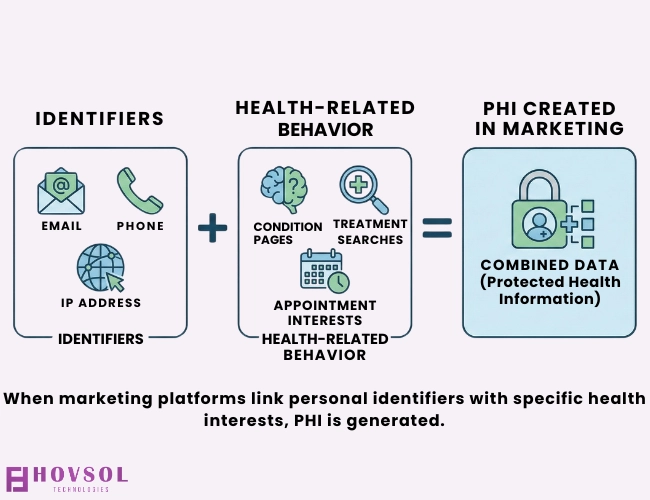
HIPAA protects PHI: any health-related information that can be tied to an individual.
In marketing, violations usually happen when identifiers like IP address or email are combined with explicit or implied health interests.
If someone visits a condition page and you track them for ads, that pattern can create PHI.
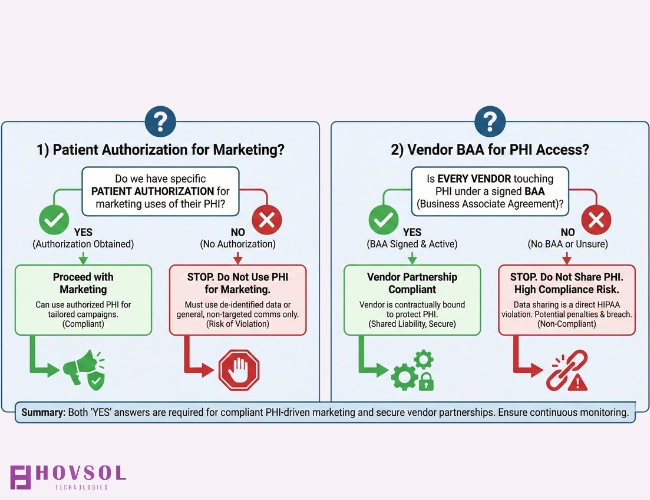
HIPAA marketing rules focus on two big questions.
First, do you have valid patient authorization to use PHI for marketing, not just treatment or operations?
Second, are all vendors touching PHI covered by Business Associate Agreements and proper security safeguards?
If the answer to either is no, the campaign is not compliant.
Tracking Technologies and Pixels
Recent guidance makes clear that common web tracking tools can create PHI risk.
On pages related to conditions, treatments, or provider search, IP address, device ID, or location may be treated as PHI.
Cookie banners are not enough. Accepting cookies does not equal HIPAA patient authorization.
Pixels that send PHI to non-compliant platforms are a common source of violations.
Business Associate Agreements and Vendor Scope
A Business Associate Agreement (BAA) defines how a vendor protects PHI.
But a signed BAA alone does not fix everything.
Vendors must also implement encryption, access controls, and audit logs. Your team must configure the tools so PHI only flows where it is allowed.
Many ad platforms and free analytics tools will not sign BAAs. Those tools cannot receive PHI.
Building a HIPAA-Compliant Healthcare Marketing Tech Stack

A privacy-first stack does not start with tools.
It starts with a data map.
List where visitors land, what they can click, which forms they submit, and where each field flows.
Then decide which systems may contain PHI and which must stay PHI-free.
From there, you can group your marketing technology into three layers.
One, systems that never touch PHI and can be standard tools.
Two, systems that might touch PHI and must be HIPAA-compliant.
Three, systems that sit between them, such as customer data platforms, that de-identify and govern data.
CRMs, Email, and HIPAA-Compliant Marketing Automation
Your CRM and marketing automation platform are the beating heart of digital campaigns.
In healthcare, they also sit closest to PHI.
Some organizations use one stack for prospects and another for patients.
For example, a CRM or marketing hub may handle anonymous leads and general education, while an EMR or patient portal manages clinical details.
HIPAA-compliant CRMs and marketing automation platforms go further.
They support encryption, role-based access, audit trails, and BAAs.
Platforms like LeadSquared and the emfluence Marketing Platform position themselves as HIPAA-compliant options for automation, email, and engagement.
The key is to configure them with minimal necessary PHI, clear segmentation, and strict consent tracking.
HIPAA-Compliant Email and SMS
Email and SMS remain powerful channels for reminders, education, and nurturing.
Under HIPAA, marketing emails or texts that involve PHI usually require specific patient authorization.
Your email or SMS platform must support encryption, consent records, opt-out handling, and BAAs where PHI is present.
“Standard” email tools may still be used for broad, non-PHI content.
But once messages reference conditions, treatments, or past visits, you need HIPAA-compliant email marketing platforms and texting solutions.
Automation workflows should always check consent status and message type before sending.
HIPAA-Compliant Analytics, Tracking, and Performance Marketing
Analytics are where many healthcare marketing stacks break.
Traditional analytics solutions collect URLs, IP addresses, and behavior data in a single profile.
On regulated pages, that combination can become PHI.
Some privacy-first stacks use HIPAA-compliant analytics tools that sign BAAs and support server-side collection.
Alternatives like Mixpanel, Heap, or Amplitude can be deployed with strict controls and a BAA in place.
You can also introduce a healthcare-focused customer data platform.
Platforms such as Freshpaint or other healthcare privacy platforms can capture events, de-identify PHI, and then forward compliant data to ad and analytics tools.
Server-side tracking further reduces risk.
Instead of sending data directly from browser to vendor, traffic flows through your secure server or privacy platform.
There you can strip identifiers, hash values, or block sensitive events.
Performance Marketing Under HIPAA
HIPAA does not ban performance marketing.
It bans impermissible disclosure of PHI to non-compliant vendors.
That means you cannot upload patient lists to ad platforms that will not sign BAAs.
You cannot retarget people based on condition pages if the tracking sends PHI to tools that are not covered.
Instead, privacy-first teams lean on context, aggregated insights, and HIPAA-compliant demand-side platforms.
Some DSPs, like Illumin, sign BAAs and support privacy-first targeting strategies that avoid exposure of PHI.
AI, Chatbots, and Automation Under HIPAA
AI and machine learning are now baked into many healthcare martech tools.
They score leads, predict appointment likelihood, and personalize content.
They also power chatbots that answer questions and book visits.
The same PHI rules still apply.
AI tools cannot freely ingest PHI unless they are covered by HIPAA safeguards and BAAs.
Healthcare-focused CDPs, CRMs, and AI platforms often embed models within a compliant environment, rather than sending raw PHI to general-purpose AI APIs.
On websites, HIPAA-compliant chatbots and live chat tools sit inside your secure stack.
Vendors like Smartbot360 and healthcare-ready live chat platforms offer encryption, access controls, and healthcare-specific workflows.
Your configuration choices matter as much as the vendor.
Disable open text fields where users might overshare.
Route sensitive questions into portals or phone calls.
Train AI assistants on de-identified data where possible.
Balancing Personalization, Performance, and Privacy
Healthcare leaders worry that compliance will kill personalization.
The reality from the sources is more nuanced.
You can still personalize, but you must change what you personalize on.
Instead of segmenting on diagnoses, you focus on intent signals, content consumption, and lifecycle stage.
You can deliver tailored education journeys without exposing PHI.
For example, send follow-up content about joint health to visitors who read general orthopedic articles, without storing that behavior alongside a named patient record.
Email and automation workflows can use consented attributes, like preferred location or communication channel, while keeping clinical details in protected systems.
Governance, Consent, and Cross-Team Collaboration
HIPAA-compliant marketing is a team sport.
Marketing, legal, compliance, IT, and clinical leaders all need shared visibility into data flows.
From the sources, several governance patterns emerge.
First, treat consent as a data object.
Track what each person agreed to, when, and through which UI.
Use workflows that check consent before sending campaigns, especially email, SMS, and retargeting.
Second, define which systems may hold PHI.
For example, EMR, patient portal, contact center tools, and specific HIPAA-compliant CRMs.
Third, document approved tools and create playbooks for common journeys.
This lets new marketers join without accidentally repeating old, risky patterns from non-healthcare industries.
Websites, Forms, Accessibility, and Consent UX
Your website is often where PHI risk begins.
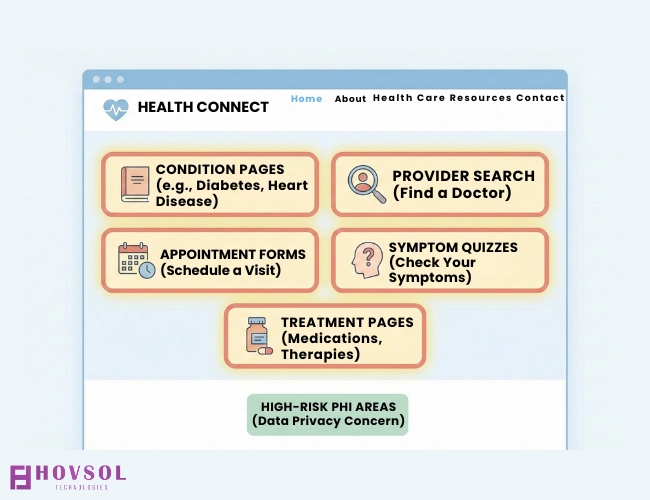
Condition pages, provider search, self-assessment quizzes, and appointment forms generate sensitive signals.
Privacy-first design can reduce risk and build trust.
Use clear, dismissible UI for consent banners and preference centers.
They should be easy to close, easy to understand, and free from dark patterns.
Explain what data you collect, how it is used, and when it may involve PHI.
Forms should collect only what you truly need.
Avoid open text boxes asking “why are you contacting us” if responses might include detailed diagnoses.
Instead, use structured fields and route deeper conversations into secure portals.
Accessibility and a11y also support privacy.
Readable fonts, good contrast, keyboard navigation, descriptive labels, and alt text help all users understand what they are agreeing to.
Accessible consent UI reduces accidental opt-ins and mis-clicks that could undermine trust.
How to Evaluate HIPAA-Compliant Marketing Vendors and Tools
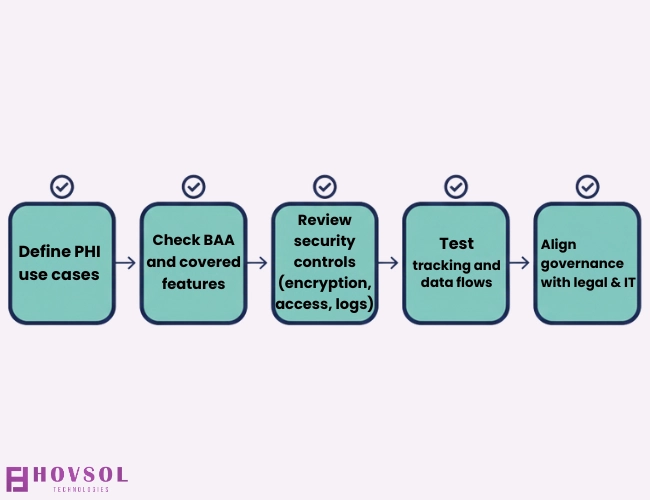
When you evaluate a new tool, look beyond the sales pitch.
Start with a simple checklist.
Will the vendor sign a BAA, and on which plans?
Do they describe technical safeguards like encryption, access control, and audit logging?
Have they documented how their product is meant to be used in HIPAA-regulated environments?
Next, test how the tool fits your data map.
Can you restrict which fields flow into it?
Can you separate PHI-bearing projects from general campaigns?
For martech with AI features, ask how training works.
Is your data used to train shared models, or are models isolated per customer?
Finally, run a joint review with legal, compliance, IT, and marketing before rolling out.
Decide what “good enough” risk looks like for your organization, and document it. For organizations ready to operationalize these guardrails, explore ourAI-powered business process and compliance automation solutions to connect workflows, approvals, and regulatory updates into one streamlined system.
Generic Martech vs HIPAA-Compliant Healthcare Martech
| Approach | How It Works | Benefits for Healthcare Teams | Limitations / Risks |
|---|---|---|---|
| Generic martech stack | Standard CRMs, analytics, pixels, and email tools collect rich behavioral data and identifiers in one profile. | Fast setup, familiar tools, broad integrations, strong optimization features. | Often no BAA, default tracking can mix PHI and identifiers, high risk of impermissible disclosures. |
| HIPAA-compliant healthcare martech stack | CRMs, CDPs, analytics, and forms are chosen for HIPAA alignment, BAAs, and PHI controls. Data is segmented and de-identified where needed. | Enables digital growth while protecting PHI, clearer governance, easier collaboration with compliance teams. | Requires more upfront design, possible higher cost, and careful configuration to stay within guardrails. |
| Manual compliance checks | Teams review campaigns, screenshots, and data flows by hand before launch. | Raises awareness, can catch obvious issues, works for low-volume environments. | Slow, error-prone, hard to scale, relies on individual memory rather than systemic safeguards. |
| Tech-enabled / AI-assisted compliance | Tools enforce rules through data mapping, role-based access, consent logic, and automated checks on events and fields. | Scales across channels, reduces human error, supports continuous monitoring of digital marketing compliance. | Still requires governance, clear policies, and occasional overrides for unusual use cases. |
FAQs
1. What does HIPAA actually say about marketing emails and texts?
HIPAA treats many marketing emails and texts that involve PHI as regulated communications. If a message references conditions, treatments, or past care, you generally need explicit patient authorization for marketing. Messages must also be sent through HIPAA-compliant email or SMS platforms with proper safeguards.
2. Can we use third-party email tools for PHI?
Yes, but only under strict conditions. You need a platform that offers HIPAA-compliant email marketing, will sign a BAA, and supports encryption and consent tracking. Standard email tools may still be used for broad educational content that never includes PHI.
3. How do we know if a vendor is truly HIPAA compliant?
Look for more than a marketing tagline. Confirm they sign BAAs, describe their safeguards, and explain which products and plans are covered. Cross-check their documentation with your legal and compliance teams, and verify that your configuration avoids unnecessary PHI.
4. Can we use AI tools with PHI in marketing?
Only if those AI tools are deployed inside a HIPAA-aligned environment. That usually means a vendor who signs a BAA, supports encryption, and keeps your training data isolated. When in doubt, keep AI-driven marketing activities focused on de-identified or aggregated data.
5. Are Shopify, Wix, or generic website builders HIPAA compliant?
Most generic website builders are not HIPAA-ready out of the box. Some can be configured with compliant hosting, secure forms, and add-ons, but that requires careful design. Many teams instead rely on CMS platforms and form tools explicitly described as HIPAA-capable in industry guidance.
6. Can we still run retargeting campaigns under HIPAA?
Retargeting is possible, but the rules are strict. You cannot send PHI to ad platforms that will not sign BAAs. You also cannot retarget individuals based on condition-related behavior if that data flows to non-compliant tools. Contextual and aggregated strategies are safer.
Build Growth on a Foundation of Trust
HIPAA-compliant marketing automation is not about saying “no” to digital growth.
It is about deciding where and how PHI flows, then choosing tools and workflows that respect those boundaries.
Privacy-first design, compliant analytics, and HIPAA-ready CRMs give you room to scale.
When you map data carefully, collect informed consent, and invest in accessible, dismissible, and respectful UI, you earn more than clicks.
You earn patient trust.
If you are modernizing your healthcare marketing stack, start with privacy.
Align stakeholders, choose vendors that support HIPAA, and let automation and AI work inside clear guardrails.
That is how you build sustainable, compliant, and patient-centered growth.
Table of Contents
- Key Takeaways
- What Is Privacy-First, HIPAA-Compliant Healthcare Marketing?
- Key HIPAA Marketing Rules Every Healthcare Marketer Should Know
- Building a HIPAA-Compliant Healthcare Marketing Tech Stack
- CRMs, Email, and HIPAA-Compliant Marketing Automation
- HIPAA-Compliant Analytics, Tracking, and Performance Marketing
- AI, Chatbots, and Automation Under HIPAA
- Balancing Personalization, Performance, and Privacy
- Governance, Consent, and Cross-Team Collaboration
- Websites, Forms, Accessibility, and Consent UX
- How to Evaluate HIPAA-Compliant Marketing Vendors and Tools
- Generic Martech vs HIPAA-Compliant Healthcare Martech
- Build Growth on a Foundation of Trust