


Your website is ranking. It looks great. But none of that means you are citation ready.
Here is what I mean. When a buyer asks ChatGPT how to choose a CRM for a mid-size sales team or asks Perplexity to summarize the top AI automation platforms, the answer they get is not a list of links.
It is a synthesized response pulled from sources those AI systems trust and to be on that list and get cited, you need to build the authority LLMs can trust and easily understand.
Marketing teams have spent the last two years adopting AI tools for content production. Faster briefs, quicker drafts, automated publishing.
That’s good.
But that is a production efficiency story, not a visibility story. Being findable by AI is a structural question about your website.
After working with 25+ AI tools and workflows, our team came up with a practical audit framework, built for marketing leaders, business owners and agencies who need an actionable system. Let’s dive in…
Key Takeaways
- AI readiness is about making your website easy for AI tools to access, understand, trust, and cite.
- Clear structure, direct answers, FAQs, tables, and short paragraphs improve AI visibility.
- Schema, entity clarity, and internal linking help AI understand your brand and content relationships.
- Trust signals like author bios, case studies, citations, updated content, and original data increase citation potential.
- Publishing more content is not enough; the website must be specific, credible, structured, and technically accessible.
What “AI Citation Readiness” Actually Means
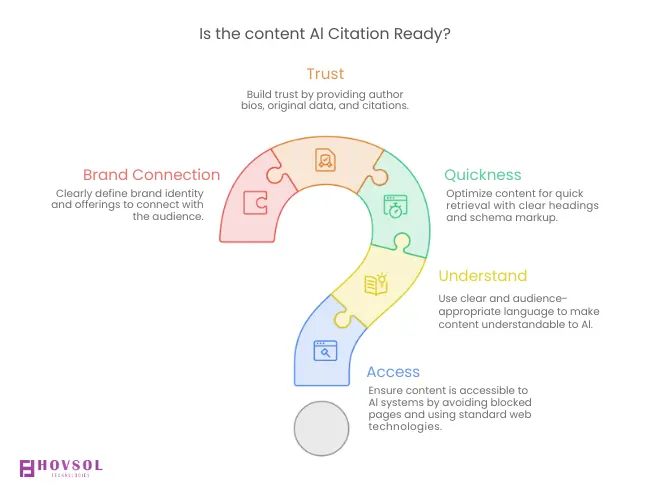
This term often gets used loosely. AI citation readiness means your website is structured, credible and specific enough that any AI system can confidently extract, use and attribute your content when generating answers.
Not every AI citation is a clickable link. Sometimes it is a brand mention. Sometimes it is your framework, rephrased without credit. Sometimes it is the competitor who answered the question more clearly.
The goal of this audit is to understand which of those outcomes you are getting, why and how you can beat your competition.
After analyzing 400+ prompt responses, we noticed that a citation ready page tends to share a few traits. It answers a specific question directly, near the top. It provides clear explanation and evidence. Its structure, headings and format make it easy to parse. It carries credibility signals that give AI systems something concrete to trust.
Think of it this way. Traditional SEO asks: can this page rank?
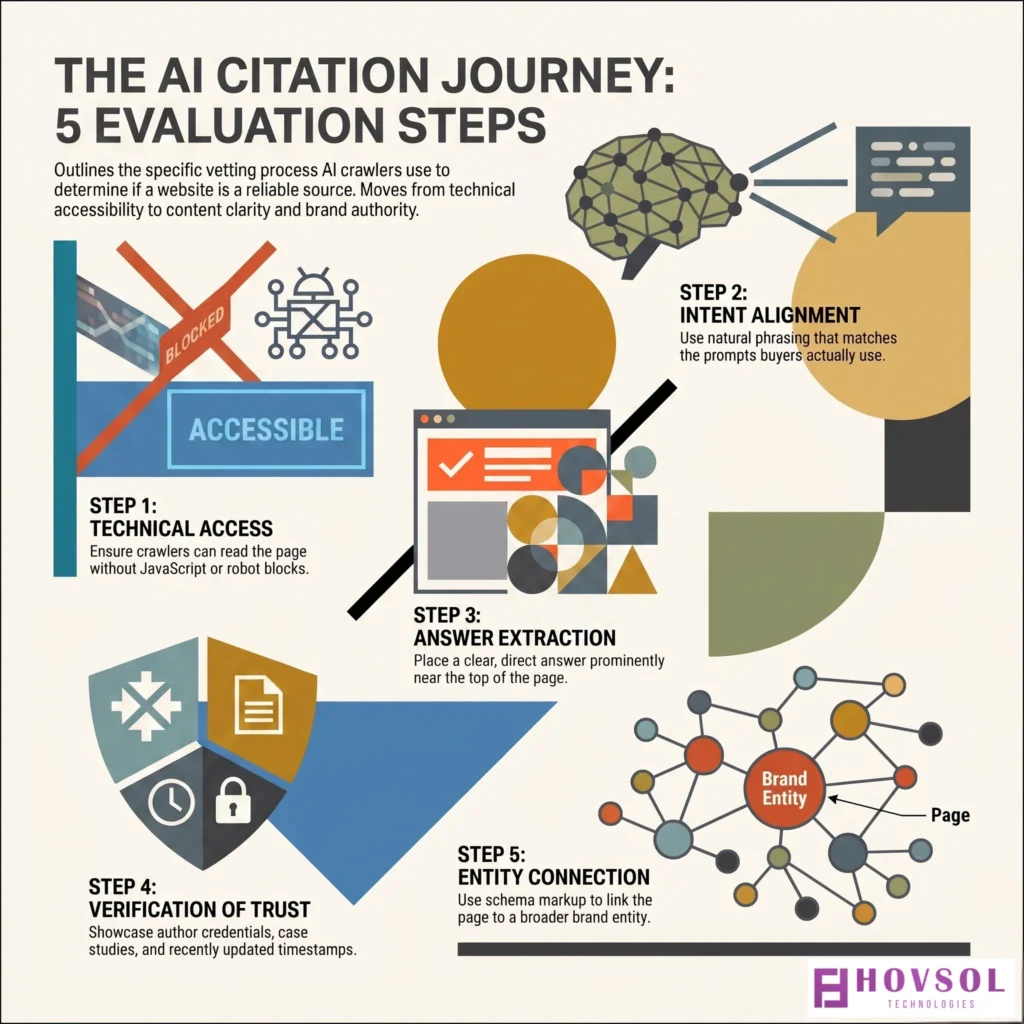
AI readiness asks five harder questions:
Can the system access this page?
If the system cannot crawl or render your page, the conversation ends there. Blocked pages, no-indexed URLs, JavaScript-heavy content that does not render server side, pricing tables stored as images, key details locked inside PDFs – any of these can mean the page effectively does not exist for the system trying to use it.
Can it understand what the page is about?
Even smart systems still rely on surface level cues to match content to queries. This is not a limitation but just how retrieval works.
Your page needs to actually use the terminology buyers use when asking questions. A page about “AI citation readiness” that never uses that phrase clearly is harder to retrieve for relevant prompts.
Keyword research still matters. The vocabulary just needs to reflect how your audience actually ask, not how marketing wants to position it.
Can it find the most useful answer quickly?
This is where structure matters most.
The system needs to know who you are, what you offer, who you serve, where you operate, why the page is relevant to the question being asked.
Content structure, schema, entity clarity and internal link architecture all contribute here.
Does it have reason to trust the source?
Authority signals give the system it can trust. Think expert authors, reviewer bios, original data, updated dates, case studies, external citations.
A service page that only says “we deliver innovative solutions” gives the system very little to work with but a specific, evidence-backed content gives it a lot more context to work with.
Can it connect this page to the rest of your brand?
The outcome can be a direct citation with a link, a brand mention, a summary of your content without attribution or nothing at all. AI visibility measurement needs to track all of these, not just traffic.
Different platforms work differently. ChatGPT’s algorithm behaves differently from Perplexity’s, which behaves differently from Google AI Overviews.
That said, most AI citation decisions run through a similar chain and marketers benefit from understanding it at a practical level.
The Audit Framework: Eight Pillars
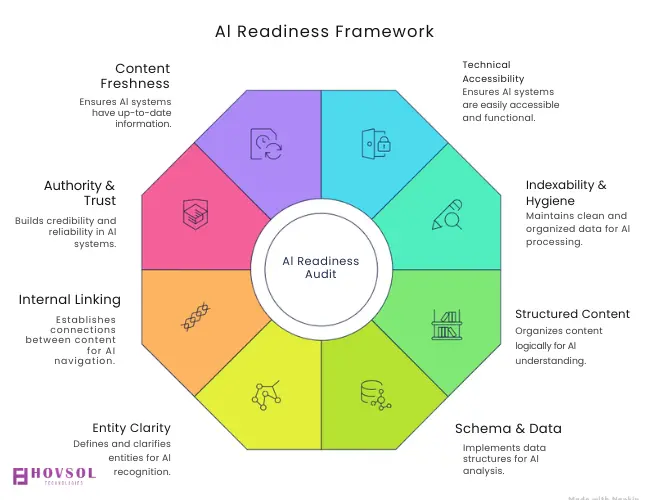
An honest AI readiness audit covers the full system. Schema alone is not the answer and neither is better blog formatting.
What follows here is the framework we use in our daily content marketing, broken into eight key areas. Note that not every business needs to act on all eight immediately, but understanding where the gaps are is the starting point.
1. Start with Technical Accessibility
Everything else is irrelevant if the system cannot access the page. For your most important pages, like your homepage, service pages, product pages, pricing, case studies, FAQs and any other page where a buyer makes a decision, ask the following.
- Are these pages crawlable and indexable?
- Are any blocked by robots.txt or marked noindex by mistake?
- Are canonicals pointing to the correct URLs?
- Is critical content loaded through JavaScript in a way that does not render server-side?
- Are pricing tables, comparison data, or service details stored as images?
- Can crawlers see the same content users see?
A common issue here is the gap between what looks complete in the browser and what is actually readable by a crawler.
A page can look polished while important service details live in a slider, a PDF, an infographic or a JavaScript-loaded tab. From an AI readiness standpoint, that information does not exist.
2. Indexability and Search Hygiene
Technical access is not enough because messy search signals can still create confusion.
Duplicate pages competing with each other, old URLs that should redirect but do not, orphan pages missing from the site structure, thin pages that add noise without adding value – all of these can choke an LLM’s capacity to pick the right information.
AI systems that rely on retrieval layers benefit from a clean, coherent site.
If your own pages are working against each other, you are making the system’s job harder and use more computational resources. But AI models are designed to use a reasonable amount of computation to keep the provider’s cost low. As a result, an AI model will simply skip your messy website and go for the competitor’s content that makes the AI’s job easier.
3. Structured Content
Structured content is content organized so that both humans and machines can easily extract what they need. Not robotic, not formulaic. Just clear.
A strong AI ready page has a clear H1, descriptive subheadings, direct answers near the top, short paragraphs, lists where lists are useful, tables for comparisons, FAQs for natural questions buyers actually ask and examples or proof points that make claims concrete.
Every major section should answer a clear question.
The CMS issue here is real and underappreciated. When all content lives inside one large rich text body field, extracting specific information becomes difficult. This is what we SEOs call the “blob body field” problem. A service page might include the service name, a summary, benefits, process steps, FAQs, pricing notes, author attribution, testimonials and related services – all mashed together in a single text editor. It looks fine in the browser. Behind the scenes, it is a wall of undifferentiated HTML.
Structured fields in a CMS separate those elements. Each gets its own space, its own label, its own ability to be validated, reused, and converted into structured data. If your CMS allows this, use it. If it does not, it is worth factoring into longer-term platform planning.
4. Schema and Structured Data
Schema markup is code that tells AI systems and search engines what your content means, not just what it says. It is the difference between a page that reads “Dr. Sarah Chen, Director of Admissions” and a page that explicitly labels that string as a Person, with a job title, an organization and a verified profile link. One leaves the system guessing. The other states a fact.
For most business websites, the minimum useful schema types are Organization on the homepage and key pages, Article or BlogPosting on content pages, Service on service pages, Person on author and team pages and BreadcrumbList on any page with meaningful navigation.
Schema is also one of the least expensive items on this list to implement. A basic rollout on the pages that matter most can usually happen in a single sprint.
But here is the part people miss. Schema is a confirmation layer, not a rescue layer. If the page is already clear, schema helps machines label that clarity more confidently. If the page is vague, adding Service schema to it does not make the offer clearer. A thin 300 word page with Article schema is still thin. The work has to happen on the visible content first.
5. Entity Clarity
An entity is a clearly identifiable real world thing: a company, a person, a service, a location, a concept.
AI systems do not just match keywords. They try to understand the actual things those keywords refer to. Vague language creates entity confusion. Specific language builds entity clarity.
For example, if a company lists “AI solutions” as a service, that tells the system almost nothing. Does it mean chatbots? Workflow automation? Predictive analytics? Document processing? AI agents?
The answer matters because different buyers are searching for different things and the AI model trying to answer their question needs to know which one applies.
Most sites define their entities inconsistently and then fail to connect them. Entity linking is the practice of connecting entities on your site to their definitions in authoritative external sources, and to related entities within your own content.
A good entity map answers who you are, what you specifically offer, who you serve, where you operate, what problems you solve and what proof backs the claim. These answers need to be consistent across the site, not scattered with different terminology on every page.
For local businesses, this matters in a very specific way. A healthcare provider with locations in multiple cities is vulnerable to geographic confusion. A system trying to answer “assisted living near me” queries might conflate a location in Phoenix, Maryland with Phoenix, Arizona, unless the site has explicitly linked its location entities to authoritative geographic sources, used schema properties like sameAs to connect each location to its Wikipedia or Wikidata entry and used areaServed to clarify which geographic region each page covers.
Entity linking is not a massive technical undertaking. It starts with identifying the entities your authority depends on, then linking them consistently.
6. Internal Linking and Site Architecture
Internal linking matters more for AI than it ever did for traditional SEO.
AI systems crawl the relationships between pages to build a picture of what a brand covers and how its topics connect. A weak internal link structure leaves the system looking at a collection of disconnected pages with no clear story.
A blog about AI citation readiness should link to related service pages. Service pages should link to relevant case studies. Case studies should link back to the services they demonstrate.
Author bios should link to the content they have authored.
Location pages should link to the services available at each location.
Specific things to fix first: vague anchor text like “click here” or “learn more,” service pages that do not link to proof assets, blogs that are published and then never connected to anything and orphan pages sitting at the edge of the site with no incoming internal links.
7. Authority and Trust Signals
This is perhaps the most important yet overlooked factor. AI systems need confidence in their sources. That confidence comes from more than clean structure.
Expert author bios with credentials, reviewer attribution on technical or medical content, updated dates, citations to credible third-party sources, original research, proprietary data, case studies with real outcomes, client examples, awards, certifications, editorial policies and consistent brand information across the web. All of these contribute.
This is especially important in industries where trust drives decisions such as the YMYL category like healthcare, legal services, finance, B2B consulting, education.
A service page that only describes the service in abstract terms gives the system nothing specific enough to cite. A stronger version explains the service, names the audience it helps, describes the process, connects the outcomes, and shows the experience behind the claim.
Backlinks still play a major role in earring AI trust just like it does for traditional SERP rankings. Backlinks are like digital endorsements from other publications and prove to AI algorithms that other authoritative entities vouch for your information’s accuracy. When your brand is frequently referenced or linked to in other reputable publications, social media, trusted domains, the AI builds a semantic association that you are a trustworthy source for that topic.
8. Content Freshness and Accuracy
AI systems generally prefer current, accurate information.
Outdated service descriptions, old pricing references, legacy team pages for people who have left, blog posts that reference regulations that have since changed can create credibility conflicts.
Freshness does not mean publishing constantly. It means keeping important pages current, fixing inaccuracies when they appear and maintaining enough update cadence that the site does not look abandoned.
What AI-Friendly Content Actually Looks Like
There is a practical difference between content that reads well and content that AI systems can easily extract and reassemble. They overlap but not the same thing.
LLMs analyze the order in which information appears. They look at the heading hierarchy, use formatting cues like bullet points, tables and bolded summaries. They notice redundancy and reinforcement, which is how they gauge what the page thinks is important. This means poorly structured content can fail even when it has schema markup. And a clear, well-organized blog post might get cited without a single line of JSON-LD.
A few structural habits that make a real difference.
Lead with the Answer
LLMs tend to prioritize what appears early in the content. If the thesis, definition or takeaway is buried in paragraph nine, it may not make it into the synthesized answer. Put your best information near the top. Then expand.
Keep Paragraphs Short and Self-contained
Explain one idea per paragraph.
Long paragraph blocks increase the chance that a system extracts the wrong portion or skips the section entirely. Short, segmented writing helps both readers and AI models follow the logic without losing the thread.
Use Structured Formats
If content can become a step-by-step guide, a numbered list, a comparison table or a bulleted breakdown, do that. AI summarizers actively favor these formats. Bullets, tables and Q&A sections are easier to lift cleanly.
Use Semantic Cues
Phrasing like “In summary,” “The key point is,” “Step 1,” or “The most common mistake” helps systems identify the role each passage plays. These signals help the model understand what kind of information it is reading.
Cut the Noise
Interruptive popups, modal windows, endless CTAs and disjointed carousels pollute what the system sees.
Even when a user closes them, they often remain in the DOM.
Think of your content like a transcript: if it would be hard to follow when read aloud, it may be hard for an AI to parse, too.
What KPIs to Measure
Marketing performance is directly tied to numbers. The good news is that AI readiness is more measurable than most teams currently track.
AI Citation Share
How often your website is cited for target prompts versus competitors. Build a prompt set of 30 to 50 buyer questions. Test them monthly across ChatGPT, Perplexity, Gemini, Copilot, and Google AI Overviews. Log who gets cited.
Use this log to run deeper analysis into why your competitors are getting cited over you as well as what’s working for you in getting cited.
Brand Mention Accuracy
Do AI systems describe your company correctly? Wrong descriptions, outdated service lists or misattributed capabilities are all fixable but only if you are checking.
Competitor Citation Gap
Which competitors are being cited for prompts where your brand is absent. This tells you where the content gap actually lives.
Query Coverage
How many important buyer questions your site can support with strong, citation ready pages. Many sites cover the broad questions and miss the specific ones where purchase decisions happen.
Schema Coverage
What percentage of priority pages have accurate, validated, relevant schema. This is auditable in a single crawl.
AI Referral Sessions and Assisted Conversions
Traffic from AI platforms where it can be tracked in GA4 and conversions that may have been influenced by AI discovery even when the final channel is direct or branded search. Attribution is imperfect here, but tracking the trend still matters.
A Quick Reference Checklist
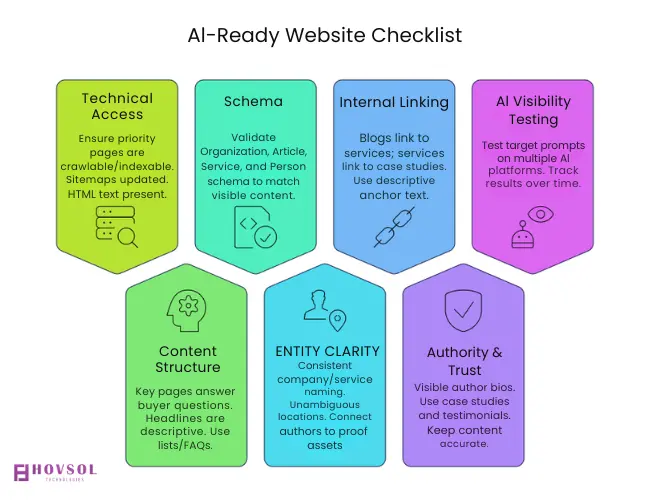
Run through this before you call your site AI ready.
Technical Access
- Priority pages are crawlable and indexable
- No important pages blocked or noindexed by mistake
- Sitemaps are clean and updated
- Key content is present as HTML text, not trapped in images or scripts
Content Structure
- Each key page answers a clear buyer question
- Headings are specific and descriptive
- Direct answers appear near the top
- Paragraphs are short and each covers one idea
- Lists, tables and FAQs are used where they serve the reader
- Examples and proof points are included
Schema and Structured Data
- Organization schema on homepage
- Article or BlogPosting schema on content pages
- Service schema on service pages
- Person schema on author and team pages
- All schema validated and matching visible page content
Entity Clarity
- Company is clearly and specifically described
- Services are named consistently across the site
- Locations and service areas are unambiguous
- Authors, experts and proof assets are connected
- Official profiles linked through sameAs where relevant
Internal Linking
- Blogs link to relevant service pages
- Service pages link to case studies and supporting resources
- Anchor text is descriptive
- No orphan pages sitting disconnected from the structure
Authority and Trust
- Author bios are visible and credible
- Case studies, testimonials, examples support key claims
- Important pages are current and accurate
AI Visibility Testing
- Target prompts tested across multiple AI platforms
- Competitor citations documented
- Brand descriptions checked for accuracy
- Results tracked over time
A Quick Before and After
Weak version: “Our AI solutions help businesses transform their digital presence with future-ready innovation.”
What is the service? For whom? What problem does it solve? What is the process? What does a client get? None of that is answerable from those words.
Stronger version: “Our AI readiness audit helps marketing teams determine whether their website can be found, understood, and cited by AI search systems. The audit covers technical access, schema markup, content structure, internal linking, entity clarity, authority signals, and AI citation testing across platforms like ChatGPT, Perplexity, Gemini, Copilot, and Google AI Overviews.”
Using AI to Write Content is Not the Same as Being AI Ready
This is a rookie mistake but still very common. Teams adopt AI writing assistants, produce more content and assume the volume is doing something for their visibility.
It doesn’t.
AI tools can draft content faster. They cannot fix poor site structure, weak internal linking, missing schema, vague service descriptions or content that hides inside images and PDFs.
One agency we worked with had published over 50 AI assisted blog posts in a single quarter. The content sounded fine but they lacked zero meaningful schema, no internal links back to service pages, no author bios. It just did not function as a coherent website.
Just publishing more pages without strategic structure is just noise with better grammar.
Same word count, approximately. One answers the question. One does not. AI-ready content is not necessarily longer. It is more specific.
Summary
Your buyers are already getting answers – do those answers mention you?
AI readiness means consistently watching the gap that is already costing businesses citations, brand mentions and buyer trust at the point of decision.
The companies getting cited by ChatGPT, Perplexity, and Google AI Overviews are not winning because of a miracle hack. They are winning because their websites are clearer, better structured and more trustworthy as sources.
That is achievable. It requires the kind of strategic work that has always mattered in SEO: being specific, being credible and being findable by the people making decisions.
The audit above tells you where your site stands. The roadmap tells you how to close the gaps.
Start with your top ten pages. Run the prompts. See who is being cited instead of you.