


An effective AI content strategy is a system for producing content that is useful, specific, reviewable and credible enough that both humans and AI systems trust it. That difference matters because a low trust AI content would be ignored by readers, internal teams will distrust it and AI driven searches will simply overlook them.
Your readers/viewers can fairly accurately tell an AI generated content within the first 30-40 seconds based on sentence uniformity, lack of specific examples and absence of verifiable expertise markers and lose interest.
The problem isn’t output quality. The real problem is trust.
A lot of teams miss that.
An AI generated content is not broken. It’s just weak, too broad, too clean, too forgettable.
This framework addresses content trustworthiness through five specific pillars and its a repeatable AI content production framework with human-in-the-loop.
What is an AI Content Strategy
The simple definition is that an AI content strategy is a structured operating model for using AI in content planning, drafting, editing, optimization and measurement without losing brand voice, factual accuracy, audience fit or editorial judgment.
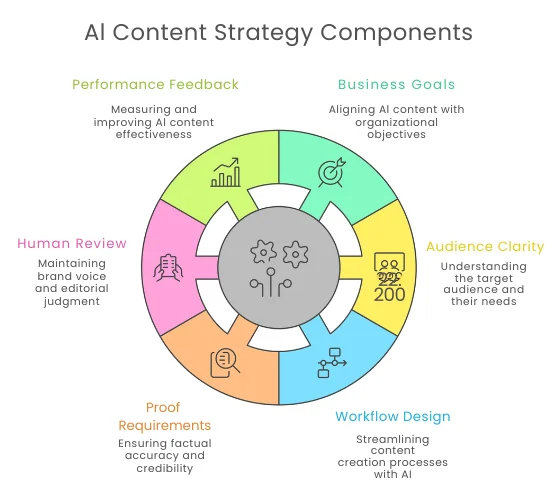
To be more concrete, a real AI content strategy includes six working parts
- Business goals
- Audience and intent clarity
- Workflow design
- Proof requirements
- Human review standards
- Performance feedback loops
A prompt is a tool. A strategy is a system.
If a team says it has an AI content strategy but what it really has is a shared prompt doc, one writing tool and a vague plan to “humanize the output later,” that team does not have a strategy. It has tool access.
A working strategy answers practical questions early,
- Who is this content for
- What problem is this content solving
- What proof does this content need before publication
- What should AI handle
- What should humans still own
- What should success look like after publication
Without those answers, the draft usually goes soft. It sounds polished but it is built on weak decisions.
Why Reader Trust in AI Content Collapsed
Digital content trust scores dropped 34% between January 2023 and December 2024, according to the Edelman Trust Barometer for digital media.
Readers developed pattern recognition for AI-generated content markers including perfect grammar consistency, encyclopedic neutrality and absence of experiential knowledge.
A research paper published in Cornell University shows users prefer AI content initially, but that interest drops once they’re told it’s AI-generated. And repeated exposure to AI content can reduce trust and acceptance over time.
Most weak AI content fails for the same reason. The language is plausible, but the thinking underneath it is thin.
That distinction matters. Here are some examples we commonly see across AI authored soft write ups:
- A weak article says, “Businesses should balance AI efficiency with human oversight.” That line is not false. It is just too broad to guide a real decision.
- A weak draft makes recommendations without examples, source grounding, SME review, product context or operational detail. Readers may not label that as a proof problem, but they notice it.
- A SaaS content leader, an agency owner and a B2B buyer do not bring the same pressures to the page. Content that treats them like the same reader will sound synthetic.
Teams often think they have an AI writing problem when they really have an upstream decision problem. The draft gets blamed because the draft is visible. The real issue happens earlier due to weak brief, unclear audience, missing proof, no agreement on what the piece is supposed to do.
So the team rewrites.
Then rewrites again.
Then swaps tools.
And the quality barely moves.
That outcome is not surprising. If the input is vague and the editorial standard is soft, the prompt is not the real bottleneck. In practice, the biggest improvements usually come from fixing the brief, the evidence, and the review process before touching the prompt again.
Plus, Google’s algorithm updates in March 2024 and September 2024 specifically targeted mass produced AI content, leading to stricter scrutiny of a content’s depth and originality.
AI is immensely useful in creating the outline, doing the research, gathering sources faster. But you need a
Pillar 1: Verifiable Expertise Markers Machines can Extract
AI writing models are great at mimicking authoritative tone because of the tremendous amount of industry terminology and formatting structure they are trained on. But that’s surface level authority and lacks the specific proof points that demonstrate actual expertise.
Real expertise manifests through extractable details that AI language models cannot fabricate. These include specific campaign metrics from your dated projects, counterintuitive insights that contradict published best practices, honest documentation of failure cases with causal explanations and more.
That verifiable expertise integration works through some specific steps:
Let AI tools generate structural frameworks and compile background research. Then your subject matter expert, with domain experience, rewrites all claims to include verifiable specifics. Every general statement receives a concrete example drawn from actual project work. All statistical claims should include source attribution and temporal context.
Here’s an example:
Weak expertise claim:
“Email marketing campaigns require careful audience segmentation for optimal performance.”
Strong expertise claim:
“HOVSOL segmented our SaaS trial email list into 12 micro audiences based on product feature usage patterns in Q3 2024, increasing open rates from 18.3% to 34.7% for trial conversion sequences but the segmentation setup required 21 days of data cleaning and caused our email service provider Mailchimp to hit API rate limits twice.”
In the stronger version, a machine can extract the expertise signals through
- The specific metric ranges with baseline and outcome values (18.3% → 34.7%)
- Named tools with version specifications where relevant (Mailchimp)
- Timeline precision using quarters or specific date ranges (Q3 2024, 21 days)
- Counterarguments acknowledging contexts where the approach fails
Pillar 2: Original Research Data Assets
Original research signals unreplicable expertise because AI language models synthesize existing information but cannot collect new empirical data from real-world sources.
You don’t require laboratory grade research infrastructure to create citation-worthy data assets. Here are some easy to plan and execute research you can run:
Customer interview pattern analysis
Conduct structured interviews with 5-8 customers using identical question sets. Pattern-match responses to identify recurring themes. Document quantitative frequency of specific answers.
Competitive tool comparison testing
Deploy 3-5 competing tools for identical use cases over 14-30 day periods. Capture performance metrics, implementation obstacles, and cost differentials with screenshots.
Audience perception surveys
Collect a minimum 50 responses using Google Forms or Typeform. Focus on specific belief patterns rather than broad satisfaction scores.
A/B test documentation with sanitized metrics
Document controlled experiments from actual marketing campaigns. Share directional results (which variant won) and relative performance gaps (Variant B achieved 2.3x conversion of Variant A) without exposing confidential revenue numbers.
In these cases, research scale matters less than the research exclusivity.
A 50 person survey about a specific question that no published research addresses provides more trust value than citing a 10,000 person industry report that 200 competitors also reference.
Pillar 3: Distinct Perspective Based on Direct Experience
AI language models optimize for neutrality and/or balanced viewpoint presentation. This also makes AI to carefully avoid definitive positions.
Human readers trust other humans who showcase clear positions or opinion based on lived experience.
Here is an example.
Weak AI-generated perspective:
“Content marketing strategies vary significantly across different business contexts, with each approach offering distinct advantages and disadvantages depending on organizational goals, resource availability, and target audience characteristics.”
Stronger, experience based perspective:
“Enterprise SaaS content marketing fails 73% of the time because companies create educational content about topics their buying committees never search for. We analyzed 156 enterprise SaaS content programs and found that 114 of them published content optimized for individual contributor searches (how to use tools) rather than executive-level searches (business case justification). This mismatch explains why these programs generated website traffic but produced zero pipeline impact after 6-9 months of consistent publishing.”
- Machine extractable perspective markers:
- Specific challenge to conventional wisdom with named belief being contested
- Quantitative claim drawn from direct analysis (73% failure rate, 156 programs analyzed)
- Causal explanation for the pattern (search intent mismatch)
- Falsifiable assertion that readers can verify or dispute
Developing a perspective means accepting that portions of your audience will disagree with your position. If your strategy is to optimize for maximum keyword coverage and minimum audience, you will produce invisible content in trust based environments.
Pillar 4: Process Transparency with Explicit Limitations
AI content generation favors confident declarative statements. Think about an article like “The five steps to achieve X” delivered with algorithmic certainty.
Practitioners with implementation experience know that methodology application involves context dependent variables and occasional failure modes.
One of our client’s article “Why This Framework Failed for 33% of B2B Enterprises” achieved 2.7x higher conversion to consultation bookings compared to our “perfect system” content in Q4 2024. The transparency about failure cases and the learning from that failure attracted buyers who valued honesty over marketing polish.
Transparency based trust building outperforms perfection based positioning in B2B contexts where purchase decisions involve risk assessment.
Methodology disclosure
Explain research collection methods, sample sizes, and analytical processes. If AI tools are used to analyze, specify which tools performed which functions (Claude 3.5 Sonnet analyzed 1,200 customer support transcripts for recurring complaint themes).
Knowledge boundary acknowledgment
State contexts where recommendations have not been tested.
When we published our content research we made that explicit disclaimer – “This approach has not been validated for regulated industries with content approval requirements exceeding 14 days.”
Contextual applicability parameters
Define the specific conditions where advice applies:
“This strategy works for B2B SaaS companies with annual contract values between $12,000-$150,000 selling to companies with 50-500 employees.”
Commercial relationship disclosure
Identify financial interests in recommended solutions:
“HOVSOL uses Semrush for client SEO analysis and maintains an affiliate relationship with Semrush.”
Or
“Undisclosed conflicts of interest in educational content cause deal loss in 23% of B2B sales cycles where prospects discover the conflict during vendor evaluation, based on HOVSOL’s analysis of 67 lost opportunities in 2024.”
Pillar 5: Human Writing Rhythm through Sentence Length Variation
AI language model output demonstrates consistent sentence structure patterns. GPT-4o and Claude 4.5 Sonnet both exhibit preference for sentences comprising 15 to 25 words and a parallel grammatical construction.
Human writing contains significantly higher sentence length variation and intentional rhythm breaks that vary from author to author.
Effective human rhythm uses staccato variation. Meaning three word sentences create emphasis. Then longer constructions of twenty five to thirty five words build complex ideas through subordinate clauses and specific examples that add nuance before returning to the core concept with additional supporting context.
Then back to short impact.
Develop a content analysis strategy to identify AI writing patterns so you can eliminate them during human editing.
Some of the more known patterns are generic transition phrases (in today’s digital landscape, moreover, additionally, furthermore), perfect parallel structure in all list items without variation, balanced presentation formulas (on one hand… on the other hand), hedging language that qualifies every assertion (may, might, could, potentially, often). We can keep going…
Replace these patterns with conversational markers such as industry-specific terminology, intentional sentence fragments for emphasis, open ended questions without immediate answers, grammar rule violations for the sake of storytelling effect, contractions and casual phrasing matching verbal speech patterns.
The goal is to have an authentic voice rather than grammatically perfect prose.
Framework Implementation Process
Our team at HOVSOL follows a seven step content creation process for AI assisted content that maintains human trust:
Step 1 – AI research compilation
ChatGPT performs competitive content analysis, keyword clustering and topic research.
This automation saves 4 to 6 hours per article compared to manual research.
Step 2 – Strategic outline by domain expert
Our subject matter experts review AI’s suggestions. We typically end up with 35-45% of the proposed structure eliminated/replaced with SME’s suggestions.
Experts add sections addressing unstated buyer questions that keyword research does not surface.
Step 3 – AI drafting with structural constraints
Claude Sonnet models generate the first draft following a human created outline with specific requirements for data density and entity naming.
Step 4 – Complete rewrite by practitioner
Domain expert rewrites AI draft entirely rather than light edits. General claims are replaced with specific examples from actual lived experience.
This step consumes ~70% of our total creation time.
Step 5 – Specific example injection
Theories are backed up with real application cases where applicable. Every statistic receives temporal and contextual boundaries and credible external source citing.
Step 6 – Voice optimization pass
Editors read content aloud to identify robotic rhythm patterns and is shared to at least two of our in house staff to get the first hand experience of a reader’s POV.
Based on those feedback and remarks editors add contractions, sentence length variations, eliminate parallel construction and break extended paragraphs into more digestible chunks.
Step 7 – Verification review
A second expert validates factual accuracy and trust signal presence and confirms the claims made include verifiable sources and that the expertise demonstration survives extraction of individual sentences.
This process requires 40% more time than pure AI generation.
But the content produced through this process achieves between 4.3x to 6.2 higher engagement, based on a comparison of our 40 top articles.
What AI Should Do, What Humans Must Own
Every brand producing content must have this clarity.
AI is useful for structured, repeatable, language-heavy work. Good use cases include
- Idea clustering
- Outline generation
- Draft scaffolding
- Headline variants
- Transcript cleanup
- Summarization
- Repurposing approved content
Humans still need to own work that depends on tradeoffs, accountability and consequence. That includes
- Content strategy
- audience framing
- Proof selection
- Positioning
- Sensitive claims
- Final recommendations
- Editorial judgment
- Compliance and risk review
That division of labor is not philosophical. It is practical.
When you hand off positioning, differentiation or high-stakes claims too early, the draft becomes polished but empty.
A Simple Trust Audit You can Use Tomorrow
If your team wants a fast quality check, I would start here.
Before publication, ask these questions
- Does this piece solve a real audience problem?
- Is the angle specific, or could any competitor have written it?
- What proof supports the key claims?
- What did a human contribute here besides cleanup?
- Does the content sound like our brand, not a polished template?
- Is the content shaped for the actual channel and funnel stage?
- Would a skeptical reader trust the recommendation?
- Are we measuring quality and business value, not just output?
If several of those answers feel weak, the problem is probably not the model, it’s the system around the model.
The writers who do well with AI content are rarely the loudest about AI. They are people with tighter briefs, better evidence, stronger review logic and more honesty about what still requires human judgment.
If the goal is AI search visibility, that is not some nice extra. That is the work.
Where to Start
Select one pillar for initial implementation and Master that pillar before expanding to additional pillars.
If you are a marketing agency, start with the original research pillar. Survey 50-100 clients about specific practice questions. Document the quantitative patterns and build proprietary data assets.
If you are a SaaS company, it’s better to begin with the transparency pillar. Document actual product development processes. Share feature decisions that failed and why. Enable product managers to write about building decisions.
For consulting firms, the perspective pillar might be the right fit to start off. Take definitive positions on industry practices. Challenge conventional approaches with evidence from client work. Demonstrate opinion based on implementation experience.
Chances are, your competitors will avoid this framework because it requires more time, costs more per article and produces less volume.
That market behavior creates your competitive advantage.
Table of Contents
- What is an AI Content Strategy
- Why Reader Trust in AI Content Collapsed
- Pillar 1: Verifiable Expertise Markers Machines can Extract
- Pillar 2: Original Research Data Assets
- Pillar 3: Distinct Perspective Based on Direct Experience
- Pillar 4: Process Transparency with Explicit Limitations
- Pillar 5: Human Writing Rhythm through Sentence Length Variation
- Framework Implementation Process
- What AI Should Do, What Humans Must Own
- A Simple Trust Audit You can Use Tomorrow
- Where to Start